
No Invoice Left Behind: How Smart Invoice Processing and GL Coding Protect Restaurant Profits
by Ariane Ramil, VP, Development
With an Overview of Invoice Processing in Restaurant365 (R365) and Ottimate
From daily ingredient deliveries to essential operating supplies, every vendor invoice plays a direct role in shaping a restaurant’s profitability. Yet without timely processing and accurate general ledger (GL) coding, these routine transactions can quickly turn into delayed payments, unclear financial reports, and missed opportunities to control costs. Efficient invoice management is not just an accounting function – it is a powerful driver of operational efficiency, financial clarity, and sustainable growth.
With modern restaurant accounting platforms like Restaurant365 (R365) and automation tools like Ottimate, restaurants can transform their invoice processing from a manual, time-consuming task into a streamlined, intelligent workflow. Automated invoice capture, smart GL coding, and seamless system integration provide real-time visibility into expenses and profitability. The result is faster processing, fewer errors, stronger vendor relationships, and more accurate financial reporting. By leveraging the right technology and expert accounting support, restaurant operators gain the confidence and financial insight needed to scale their business and maximize performance.
Why Timely Invoice Processing Matters

Vendor invoices represent the restaurant’s obligations for goods and services already received. Proper and timely processing of these invoices has several critical operational and financial impacts.
1. Ensures Timely Vendor Payments
Timely invoice processing allows restaurants to pay vendors within agreed payment terms. This is important because:
- Vendors prioritize reliable customers.
- Late payments may result in penalties, interest charges, or supply disruptions.
- Strong vendor relationships can lead to better pricing, priority delivery, and favorable credit terms.
In the restaurant industry, where daily operations depend heavily on timely delivery of fresh ingredients and supplies, maintaining vendor trust is essential.
2. Prevents Operational Disruptions
Unpaid or delayed invoices can lead to vendors withholding future deliveries. This can directly affect restaurant operations by causing:
- Shortages of critical ingredients
- Menu limitations
- Service disruptions
- Potential loss of revenue and customer satisfaction
Timely invoice processing ensures uninterrupted supply chain flow, allowing restaurant operations to continue smoothly.
3. Ensures Expenses Are Recorded in the Proper Period
Accurate and timely recording of invoices ensures expenses are recognized in the correct accounting period. This is essential for:
- Accurate monthly financial reporting
- Proper matching of expenses with revenues
- Reliable Profit and Loss (P&L) statements
If invoices are recorded late, expenses may appear in the wrong month, resulting in misleading financial results and poor decision-making.
4. Improves Cash Flow Planning and Forecasting
When invoices are processed promptly, restaurant management has a clear view of upcoming payment obligations. This allows for:
- Better cash flow management
- Avoidance of unexpected cash shortages
- Improved financial planning
Accurate visibility into liabilities ensures management can plan payments strategically.
The Importance of Accurate GL Coding
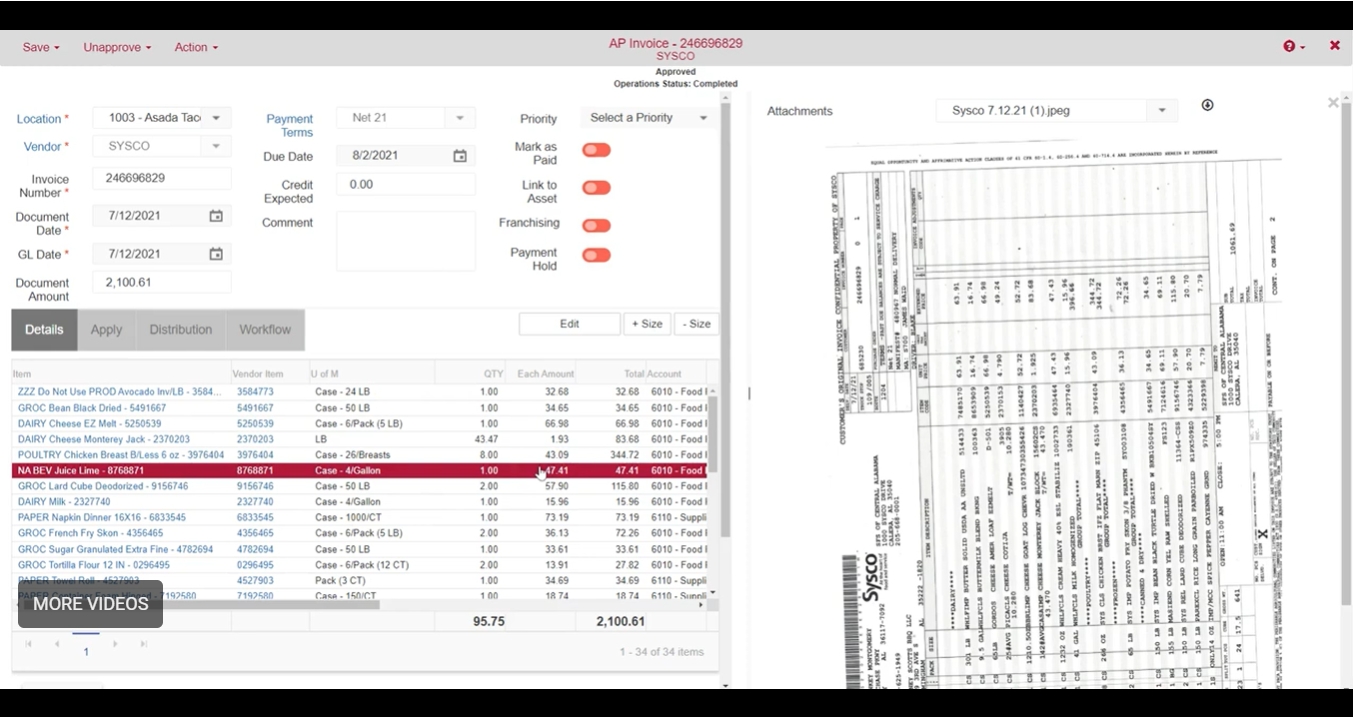
General Ledger coding is the process of assigning each invoice line item to the correct expense account and location. This step is critical for meaningful financial reporting and analysis.
1. Accurate Bucketing of Expenses
Proper GL coding ensures expenses are classified correctly, such as:
- Food Cost
- Beverage Cost
- Paper Supplies
- Cleaning Supplies
- Utilities
- Repairs and Maintenance
Accurate categorization allows restaurants to understand where their money is being spent.
2. Accurate Profit and Loss Reporting
GL coding directly affects the accuracy of the Profit and Loss statement. Incorrect coding may result in:
- Overstated or understated food cost
- Incorrect gross profit margins
- Misleading operating expense trends
Accurate P&L reporting is essential for evaluating restaurant performance.
3. Enables Meaningful Financial Analysis
Restaurant operators rely on detailed financial reports to make informed decisions. Proper GL coding allows for:
- Tracking food cost percentages
- Monitoring controllable expenses
- Identifying cost trends and anomalies
- Comparing performance across locations
This insight helps management improve efficiency and profitability.
4. Supports Budgeting and Strategic Decisions
Accurate historical expense data allows restaurants to create realistic budgets and forecasts. Management can make strategic decisions based on reliable financial information.
Overview of Invoice Processing Using Ottimate and Restaurant365
Restaurant-specific accounting software such as Ottimate and Restaurant365 streamlines invoice processing and significantly improves efficiency and accuracy.
Step 1: Invoice Capture Using Ottimate
Ottimate serves as an invoice automation platform designed to capture vendor invoices efficiently. Invoices may be received through:
- Vendor integrations
- Upload through mobile or desktop
- Scanned physical invoices
Ottimate uses Optical Character Recognition (OCR) technology to automatically extract key invoice data, including:
- Vendor name
- Invoice number
- Invoice date
- Total amount
- Line items
- Quantities and prices
This eliminates manual data entry and reduces human error.
Step 2: Automated Coding Using Memorized Rules and SKU Mapping
One of the most powerful features of Ottimate is its ability to memorize coding patterns.
When invoices from a specific vendor are processed repeatedly, Ottimate can automatically assign:
- GL account
- Location
- Department
- SKU coding (if applicable)
For example:
- Chicken breast from a food supplier can automatically map to “Food Cost – Meat”
- Cleaning supplies can automatically map to “Operating Supplies – Cleaning”
This automation improves both efficiency and consistency.
Step 3: Review and Approval Workflow
After OCR extraction and automated coding, invoices go through a review and approval process.
Accounting personnel review the invoice to ensure:
- Amount accuracy
- Correct GL coding
- Proper location assignment
- Completeness of information
Managers may also approve invoices within the system before posting.
This step ensures control and accuracy before final recording.
Step 4: Seamless Integration with Restaurant365 (R365)
Once reviewed and approved in Ottimate, invoices are seamlessly synced into Restaurant365.
The integration automatically transfers:
- Vendor information
- Invoice details
- GL coding
- Location assignment
- Expense classification
This eliminates duplicate entry and ensures consistency across systems.
Restaurant365 then records the invoice in:
- Accounts Payable module
- General Ledger
- Financial reports
Step 5: Payment Processing and Financial Reporting in R365
After invoices are recorded in R365, restaurants can:
- Schedule vendor payments
- Process check runs or electronic payments
- Track outstanding payables
- Generate financial reports
R365 automatically reflects expenses in the Profit and Loss statement, ensuring accurate financial reporting.
Benefits of Using Restaurant-Specific Systems Like Ottimate and R365
1. Increased Efficiency Through Automation
OCR technology eliminates manual invoice entry, saving significant time and labor.
Accounting teams can process high volumes of invoices quickly and efficiently.
2. Reduced Human Errors
Automation minimizes common errors such as:
- Incorrect amounts
- Duplicate entries
- Incorrect GL coding
This improves overall data accuracy.
3. Consistent and Accurate GL Coding
Memorized rules and SKU mapping ensure consistency in expense classification.

This results in more reliable financial reports.
4. Real-Time Financial Visibility
Because invoices are processed and recorded quickly, management has real-time insight into:
- Expenses
- Payables
- Profitability
This enables faster and better decision-making.
5. Seamless Integration Eliminates Duplicate Work
The integration between Ottimate and R365 ensures data flows automatically between systems, reducing manual effort and improving efficiency.
The Role of Skilled Accounting Teams in Invoice Processing

While automation improves efficiency, skilled accounting professionals remain essential to ensure accuracy, oversight, and financial integrity
Accounting teams are responsible for:
- Reviewing and validating invoices
- Ensuring proper GL coding
- Monitoring expense trends
- Reconciling vendor accounts
- Supporting financial reporting
Many restaurant groups leverage outsourced accounting teams, particularly in the Philippines, where accounting professionals are highly trained, experienced in restaurant systems like R365 and Ottimate, and provide cost-effective support.
This allows restaurant operators to maintain high-quality accounting while controlling costs.
Conclusion
Timely and accurate invoice processing and proper GL coding are critical components of successful restaurant financial management. They ensure vendors are paid on time, operations continue uninterrupted, expenses are recorded in the correct periods, and financial reports accurately reflect business performance.
Restaurant-specific accounting platforms such as Ottimate and Restaurant365 significantly enhance efficiency and accuracy through automation, OCR technology, memorized coding, and seamless integration. These tools reduce manual workload, minimize errors, and provide real-time financial visibility.
When combined with experienced accounting professionals, these systems empower restaurant operators with accurate financial data, enabling better decision-making, improved cost control, and stronger financial performance.
In an industry where margins are tight and operational efficiency is essential, investing in proper invoice processing workflows and accounting systems isn’t just an administrative necessity – it’s a strategic advantage.