

Franchise Accounting at Scale: Combining R365 Technology with Offshore Accounting Expertise
by Ariane Ramil, VP, Development
Franchising gives restaurant brands a powerful way to grow. A successful concept can expand from one location to dozens – or even hundreds – without the franchisor funding and operating every restaurant directly.
But with growth comes accounting complexity.
Franchise accounting is more than recording sales, paying bills, and preparing financial statements. It involves multiple entities, franchise fees, royalties, advertising contributions, intercompany transactions, inventory, payroll, sales tax, equipment, and location-level reporting. For restaurants, these challenges become even more complex because accounting data must connect with point-of-sale (POS), inventory, labor, and purchasing systems.
Understanding the fundamentals of franchise accounting – and having knowledgeable accountants apply the appropriate accounting treatment – is essential for maintaining reliable financial information.
The Basics of Franchise Accounting

The Importance of Standard Operating Procedures
At its simplest, a franchise relationship involves two parties: the franchisor and the franchisee.
The franchisor owns the brand, business model, trademarks, systems, and intellectual property. The franchisee operates a restaurant or other business under that brand and typically pays the franchisor fees for the right to use the brand and receive ongoing support.
From an accounting perspective, these two parties record the same economic relationship differently.
A franchisee may record payments to the franchisor as expenses or assets depending on the nature and timing of the costs. The franchisor, on the other hand, must determine when franchise-related revenue should be recognized based on the underlying contractual obligations and applicable accounting standards.
The Importance of Standard Operating Procedures
This distinction is important because simply recording a payment or invoice when cash changes hands may not produce the appropriate accounting treatment.
Franchise Accounting for the Franchisee
For the franchisee, accounting begins with establishing a properly structured chart of accounts and maintaining separate financial records for each legal entity and location.
Common franchisee accounting activities include:
- Recording initial franchise and development fees
- Accounting for royalty payments
- Recording advertising and marketing contributions
- Tracking rent, utilities, payroll, food, and other operating expenses
- Recording equipment and leasehold improvements
- Managing inventory and food costs
- Reconciling daily restaurant sales and payment methods
- Recording sales and use tax liabilities
- Managing intercompany transactions when multiple entities or locations are involved
- Preparing location-level and consolidated financial statements

One area requiring particular attention is the treatment of initial franchise fees and other upfront costs. Depending on the nature of the payment, the accounting treatment may differ from ordinary operating expenses. Capital expenditures, for example, may need to be recorded as assets and depreciated over their applicable useful lives rather than expensed immediately. Royalty and advertising payments also need to be properly classified and reconciled against franchise agreements.
For multi-unit operators, accurate entity and location tracking becomes especially important. Management should be able to determine how each restaurant is performing while also understanding the financial position of the overall organization.
Franchise Accounting for the Franchisor

The franchisor has a different accounting perspective.
Instead of primarily accounting for payments made to a brand owner, the franchisor is accounting for revenue generated from franchise relationships. This may include initial franchise fees, continuing royalties, advertising contributions, technology fees, and other contractual charges.
The timing of revenue recognition is particularly important. Under applicable revenue-recognition requirements, the franchisor needs to evaluate what goods or services it has promised to provide and when those obligations are satisfied.
For example, a franchise agreement may involve several different activities, including granting rights to use intellectual property, providing training, supporting restaurant operations, and providing continuing services. The accounting treatment should reflect the substance of those arrangements rather than simply recognizing all contractual amounts as revenue when cash is received.
Franchisors also need strong processes for:
- Tracking franchise agreements
- Calculating royalty fees
- Reconciling franchisee sales reports
- Billing franchisees
- Tracking advertising funds
- Recording franchisee receivables
- Managing development and opening costs
- Accounting for company-owned versus franchised locations
- Preparing consolidated financial statements
As a franchise network grows, these processes can become difficult to manage manually.
Why Knowledgeable Accounting Matters
Franchise accounting is an area where accounting knowledge and industry experience can make a significant difference.
Two transactions that appear similar operationally may require different accounting treatment. An accountant needs to understand not only the transaction itself but also the underlying agreement, entity structure, applicable accounting standards, and business purpose.
For restaurant franchises, accountants also need to understand restaurant operations.
A restaurant’s financial statements are closely connected to operational data. Daily sales, discounts, refunds, payment types, labor hours, food purchases, inventory counts, waste, and transfers can all affect the financial results.

An accounting team that understands both accounting principles and restaurant operations can identify inconsistencies more effectively and produce financial reports that management can actually use.
Connecting POS Systems to Restaurant Accounting

Technology has transformed the way franchise restaurants maintain their accounting records.
A modern restaurant POS does much more than process customer payments. It can provide the detailed sales and labor information that becomes the foundation for daily accounting.
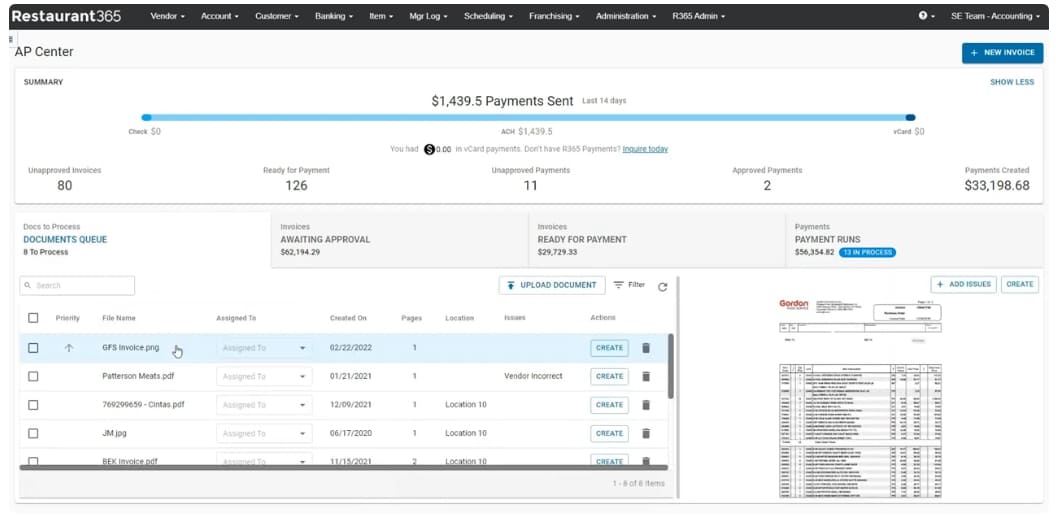
Restaurant365 (R365), for example, integrates with a wide range of POS systems and imports sales, payment, and labor information. Its Daily Sales Summary can generate accounting records that feed into the general ledger, while POS mapping determines how sales and payment information is assigned to appropriate accounts.
This integration can significantly reduce manual data entry. Instead of an accountant manually entering daily sales, properly configured systems can transfer the information into the accounting platform.
However, automation does not eliminate the need for accountants.
Someone still needs to establish the correct mapping, review exceptions, reconcile deposits, investigate variances, and verify that the accounting records accurately reflect the underlying transactions.
R365 and the Franchise Accounting Environment
Restaurant365 is designed specifically around restaurant operations and can connect accounting with POS, inventory, purchasing, labor, payroll, vendors, and banking processes. For franchise organizations, it also supports multi-location reporting and intercompany accounting.
For example, POS data can flow into R365 and generate daily sales and labor accounting records. Accountants can then reconcile those records against bank deposits, credit card settlements, cash activity, and other supporting documentation.
The result is a more timely financial reporting process.
Instead of waiting until the end of the month to understand restaurant performance, management can have access to daily or near-daily financial information. This is particularly valuable for franchise organizations where management needs to compare multiple locations and identify unusual variances quickly.
How an Offshore Accounting Team Can Support R365 Franchise Operations

As a franchise organization grows, the volume of accounting activity can increase significantly. More locations mean more daily sales, invoices, bank transactions, payroll entries, reconciliations, and month-end tasks.
An offshore accounting team in the Philippines can become an extension of the restaurant’s accounting department, supporting these processes within the client’s existing R365 environment.
A properly trained offshore team can assist with daily sales reconciliation, reviewing POS data imported into R365 and ensuring that sales, discounts, refunds, taxes, tenders, and deposits are properly recorded. They can also investigate differences between POS reports, R365 entries, and bank or merchant deposits.
For accounts payable, the offshore team can process invoices, maintain vendor records, code expenses to the appropriate accounts and locations, and prepare transactions for approval and payment. This becomes particularly valuable for multi-unit franchise organizations where invoice volume can grow rapidly.
The team can also support bank and credit card reconciliations, inventory and food-cost accounting, intercompany transactions, and month-end close procedures. Standardized workpapers and reconciliation processes can help ensure that each location follows the same accounting procedures.
Another important area is R365 data integrity. An offshore accounting team can perform routine reviews of account mappings, location coding, unusual transactions, duplicate entries, and reconciliation differences. Rather than simply entering transactions, the team becomes another layer of accounting control.
For franchisors, an offshore team can also support franchise billing and royalty-related accounting, sales reporting, accounts receivable, and location-level reporting. For franchisees, the same team can provide ongoing bookkeeping and accounting support without requiring the organization to build a large in-house accounting department.
The most effective model is not simply outsourcing data entry. It is creating a shared accounting function where the U.S.-based management team retains oversight, decision-making, and higher-level review while the Philippines-based accounting team handles defined recurring processes.
This model can provide scalability while maintaining consistency across locations.
Technology + Accounting Expertise
The most effective franchise accounting environment combines technology, standardized processes, and experienced accounting professionals.
Software can automate repetitive activities, but it cannot replace accounting judgment. A poorly configured chart of accounts or POS mapping can simply automate incorrect accounting faster.
This is why implementation and ongoing accounting review are so important.
An experienced accounting team should regularly review:
- POS-to-GL mappings
- Daily sales entries
- Bank and credit card reconciliations
- Accounts payable
- Inventory and food costs
- Labor and payroll accruals
- Intercompany balances
- Franchise fees and royalties
- Sales tax liabilities
- Fixed assets and depreciation
- Location-level P&Ls
- Month-end close procedures

Building a Scalable Franchise Accounting Foundation
Franchise growth should not require accounting complexity to grow at the same pace.
With the right accounting principles, standardized processes, knowledgeable accountants, and restaurant-specific technology such as R365 and integrated POS systems, franchise organizations can create a financial infrastructure that scales with the business.
An offshore accounting team can further strengthen that infrastructure by providing consistent, cost-effective support for recurring accounting processes while allowing internal management to focus on analysis, strategy, and business growth.
For more information, please fill out the form below. We’ll circle back with you shortly to discuss your requirements in further detail.

We’d love to Meet You In Person Or Via The Web!
If you have any questions, or just want to learn more about how our services can contribute to your operation’s success, please fill out the form and we’ll respond as soon as we can. Alternatively, call us directly at (818) 888-9579.















Leave A Comment